
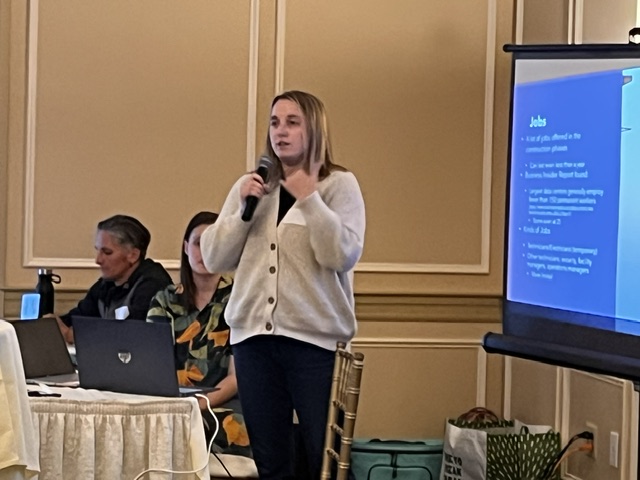
Large Trainer, Lower Chi crowd hear activists urge opposition to data center
About 100 people, many of them Trainer and Lower Chichester residents, turned out on Wednesday, Sept. 23, to hear activists present information about how they can oppose a data center proposed for their communities.
The meeting, at an Upper Chichester catering hall, was organized and led by Chester Residents Concerned for Quality Living (CRCQL). The residents heard presentations by the Delaware Riverkeeper Network and Physicians for Social Responsibility of Pennsylvania.
Many residents are upset by the news of a proposal by commercial property developer Link Logistics to develop a data center next to the Congoleum property at 4001 Ridge Rd. in Trainer. About 90% of the property is in Trainer but 10% is in Lower Chichester.
Link posted a notice in the Delaware County Daily Times Sept. 12 saying that Trainer had issued a favorable preliminary opinion for the 443,000-square-foot property that would occupy the 23-acre site. The favorable opinion indicated that the proposal conformed to existing zoning meaning Link could develop a data center “by right” without having to get zoning variances.
That does not mean that other details would not have to be worked out with the two municipalities concerning construction permitting and environmental compliance regarding air pollution, water usage and noise. Several Delaware County municipalities are in the process of enacting ordinances to regulate data centers and a model ordinance is available at the Delaware County Planning Department.
Trainer officials have been very closed-mouth about the proposal while Lower Chichester did make a public statement acknowledging they had been approached.
Anneke van Rossum of Delaware Riverkeeper Network explained that data centers come in different sizes. Data centers have been around for as long as the internet but the objection today is to giant “hyper-scale” data centers, such as those being built by Meta, Microsoft, Amazon and other tech giants, that serve artificial intelligence programs.
They cover as much as 700 acres, suck up a lot of the capacity of the electric grid and use millions of gallons of water a day to cool the microchips in as many as 5,000 servers. These data centers emit substantial air and noise pollution, especially when they run dozens of diesel generators whenever the power grid goes down.
The Trainer site would not be a hyper-scale data center. It reportedly would be a 443,000-square-foot building on 23 acres. High-tension power lines and the CSX freight line run through the site and it is bordered on two sides by residences.
Van Rossum noted that residential electric rates have already increased 14% in Pennsylvania in the last year as data centers come online all over the state. When a data center joins the electric grid, its costs for its electric demand are spread out to everyone on the grid so it never pays for all of the electricity it is using, she explained.
Pennsylvania provided data centers with sales and use tax exemptions five years ago to attract them to the state, costing the state millions of dollars in tax revenue every year. If they are designated as Keystone Opportunity Zones, they can be exempt from virtually all taxes for several years, including property taxes, putting the burden on homeowners to make up the difference. Several bills in the state Legislature are pending to repeal those tax exemptions or to regulate data centers going forward.
Josephine Gingerich, a health advocacy outreach coordinator for Physicians for Social Responsibility of Pennsylvania pointed out that most data centers are running on fossil fuel, adding to the detrimental climate and health effects of those operations.
Both speakers quoted a study that predicts there will be 400,000 additional asthma cases and up to 1,300 additional deaths annually linked to hyper-scale data centers.
Residents living near large data centers can suffer lung and heart diseases as well as ongoing stress leading to mental illness, from water and air pollution, noise and vibration, Gingerich said.
Noise pollution is especially insidious. People sleep in their basements, push mattresses up against their windows to shut out the 24-hour low hum of data centers. Whole towns have emptied out leaving just data centers, she said.
“Some people liken the noise to the low hum of conversation, but when you’re listening to that low hum 24 hours a day it can be very stressful.”
The impact on water can also be devastating. The data centers must use our drinking water because any other kind of water, such as sea water, corrodes the equipment. This can affect both well water and municipal systems, Gingerich said.
CRCQL Chair Zulene Mayfield told the crowd that they themselves must mount opposition to the Trainer project because it can only be residents of the affected towns who can speak at municipal meetings and can object to zoning and council decisions.
Mayfield noted that as of now, the public has no information about the size of the proposed data center, what companies are going to build or use it, what the plans look like, or anything else.
“It’s not a hyper-scale data center, but we just don’t know. However small it is, it has directly landed on top of us as communities,” she said.
She said CRCQL would help and provide resources but it could not lead the fight. CRCQL volunteers had to pay expensive permit fees just to pass out fliers in Marcus Hook, she said.
But she urged the residents of Trainer, Lower Chichester, Upper Chichester and Marcus Hook to band together to bring the fight to their municipal leaders, to demand information, to ask them to pass ordinances regulating data centers and to pressure them to take the side of the people they represent.
Jodine Mayberry for the Clearinghouse
PHOTO/Clearinghouse Anneke van Rossum