Monroe Energy holding office hours in Aston after major fuel leak
Reprinted by permission of Delaware County Daily Times
By Kathlen E. Carey, Feb. 18, 2026
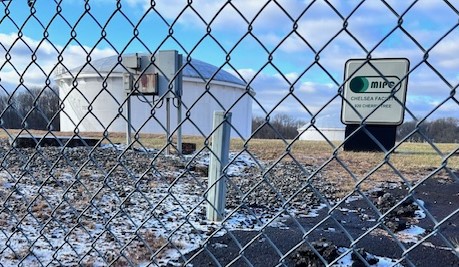
Monroe Interstate Pipeline Company will again hold office hours at the Aston Township building on March 3 following a 378,000-gallon leak at its Chelsea Tank Farm in December.
Since the leak, the company, a subsidiary of Monroe Energy in Trainer, has held a public town hall meeting and office hours in February.
The next office hours session is scheduled for 8:30 a.m. to 4:30 p.m. Tuesday, March 3 at the Aston facility at 3264 Concord Road.
“We held our first resident office day on Feb. 2 and we plan to be at the Aston Township Building on the first Monday of every month from 8 a.m. to 4:30 p.m., the hours in which Aston Township is open,” Adam Gattuso of Monroe Energy said. “Additionally, we would like to do the same in Bethel and Upper Chichester, but we have not finalized a day with the townships yet.”
The tank farm is bordered by Aston, Bethel and Upper Chichester. Monroe Interstate Pipeline Co. is a subsidiary of Monroe Energy.
State Rep. Craig Williams, R-160, of Chadds Ford, who was at the town hall earlier this month, said the cause of the leak was revealed at that time.
“After months of investigation, MIPC identified a tank near Concord Road had a major leak, caused by ‘a man-made hole created on purpose,’ ” Williams said. “We do not know at this time why someone would have drilled a quarter-inch hole in the bottom of the tank before it was placed back in service.”
He noted that MIPC participated in the town hall, as did the Pennsylvania Department of Environmental Protection, Langan, the specialty engineering firm conducting recovery efforts and the federal Pipeline and Hazardous Materials Safety Administration.
Williams said that the engineering mitigation company has recovered approximately 35,200 gallons so far, or about 10%.
The company has also set up a website to provide information to the public at chelseatankupdates.com.
It also sent a second letter to nearby residents Jan. 22 giving an update of what had occurred since their first letter was distributed on Dec. 31.
“Although there are no confirmed impacts to residential water wells at this time, MIPC continues to provide bottled water to residents with potable groundwater wells located within 1,000 feet of our western property line,” Gattuso said. “This has been an integral part of our response efforts from the beginning.”
He spoke about the monitoring efforts in place.
“We now have over 30 monitoring wells installed along our property,” Gattuso said. “These wells provide information to delineate the plume in order to allow MIPC to enhance recovery efforts and also to assist in determining if offsite impacts have occurred. Delineation efforts to the north, south, east, and southwest are complete and limited to on-site impact.”
The company spokesman said wells continued to be sampled.
“At this time, none of the over 40 residential wells that we have sampled indicate that they have been affected by this release at concentrations above EPA and/or PADEP safe drinking water standards,” Gattuso said. “Samples collected from two water wells have detections of a few compounds that are often present in gasoline but those concentrations are more than an order of magnitude (i.e., more than 10 times) below the PADEP and EPA safe drinking water standards.”
He explained that the cleanup efforts are ongoing.
“We continue to conduct extensive recovery efforts and monitoring of the air and groundwater continues,” Gattuso said. “We are undertaking these response actions in an expeditious manner as required by the PADEP order and because of our commitment to the public to be a good neighbor. We are fully committed to continuing our response and recovery actions.”
The saga began on Aug. 18, when a Monroe Pipeline operator noticed a faint odor while making routine checks in the northwest corner of the Chelsea Tank Farm, according to he company.
The source of the odor was found to be a gasoline and water mixture, about 2% gasoline to 98% water, emanating from a concrete stormwater drainage pipe. The company said it began containment at that time.
The company said it also then began a multi-month investigation into the source of the leak.
Monroe also sought and received a DEP permit to install a water treatment unit that has remained in operation.
Over the following weeks, Monroe Pipeline worked to identify and rule out potential sources, which involved excavation of the concrete pipe, several soil digs as deep as 17 feet, numerous field tank valve and flange inspections, checking underground test stations, reviewing tank level data, historical site data, and conducting static pressure tests and hydro tests of tanks in the impacted area.
They did not discover the origin of the leak until December after installing soil borings, some as deep as 35 feet. This is when they made all the necessary notifications.
On Dec. 13, they identified that one of the tanks that had been taken out of service had the quarter-inch hole in its interior floor.
Williams provided contacts for the community should they have any questions.
They include the U.S. Pipeline and Hazardous Materials Safety Administration (PHMSA) at 202-366-4595 or phmsa.pipelinesafety@dot.gov; the state Department of Environmental Protection at 484-250-5900 or RA-EP-SEROECB@pa.gov; and MIPC at 610-364-8426 or mipc1@monroe-energy.com.
“This incident affects neighbors in our district, and I remain in constant communication with DEP about testing, recovery progress, and next steps,” Williams said.
PHOTO: Clearinghouse Photo