‘Bonkers’: DOI letter halts all five in-progress offshore wind farms
Reprinted from Canary Media, Dec. 23, 2025
By Clare Fieseler
The Interior Department announced Monday it is pausing leases for all five large-scale offshore wind projects under construction in America, citing unspecified issues of national security.
Canary Media obtained a copy of a letter notifying one of the affected wind farm developers, providing new details about the move — the Trump administration’s most sweeping attempt yet to halt offshore wind construction.
A Bureau of Ocean Energy Management letter to Dominion Energy executive Joshua Bennett orders the Virginia-based utility to “suspend all ongoing activities” related to its Coastal Virginia Offshore Wind project, a 2.6-gigawatt wind farm slated to start coming online in less than four months, for “the next 90 days for reasons of national security.”
“Based on BOEM’s initial review of this classified information, the particularized harm posed by this project can only be feasibly averted by suspension of on-lease activities,” the letter reads.
The 90-day time frame is not mentioned in the Interior Department’s official statement on the order.
The letter adds that BOEM will work “in coordination with [the Department of War]” during the suspension to determine whether the risk posed by the Coastal Virginia Offshore Wind project can be mitigated. It also states that “BOEM will consider all feasible mitigation measures before making a decision as to whether the project must be cancelled.”
Ultimately, “BOEM may further extend the 90-day suspension period” based on its review of each project, according to the letter.
News of the pause was first reported by Fox News. Wind developers didn’t receive stop-work orders via letters from BOEM until roughly an hour or two later, according to a person familiar with the matter who was granted anonymity because they are not authorized to comment publicly.
The letter obtained by Canary Media mentions an “assessment” completed by the “Department of War” in November that contains “new classified information, including the rapid evolution of relevant adversary technologies and the resulting direct impacts to national security from offshore wind projects. These impacts are heightened by the projects’ sensitive location on the East Coast and the potential to cause serious, immediate, and irreparable harm to our great nation.”
There is currently one large-scale offshore wind installation operating in the U.S. — the South Fork Wind farm off the coast of New York — as well as two pilot-scale projects generating electricity near Block Island, Rhode Island, and Virginia Beach, Virginia. The letter makes no mention of these East Coast projects or any national security risks their operation may pose.
The letter was signed by Matthew Giacona, the acting director of BOEM, a young political appointee and former oil and gas lobbyist for the National Ocean Industries Association.
In October, congressional Democrats asked the Interior Department’s inspector general to investigate Giacona following revelations, first reported by the news site Public Domain, that he has used his BOEM position to work on niche policy matters previously the focus of his oil lobbying role. Giacona has not yet received Senate confirmation.
The Interior Department’s press release about the pause also cites claims not included in the letter to Dominion Energy, including mention of a 2024 Department of Energy study that determined offshore wind turbines could cause radar to “miss actual targets” while also noting that “wind energy will play a leading role in the nation’s transition to a clean energy economy.”
Dominion Energy did not respond to a request for comment.
A spokesperson for Equinor, the partially state-owned Norwegian energy firm that is developing the Empire Wind project off the coast of New York, said, “We are evaluating the order and seeking further information from the federal government.”
The Trump administration had previously hit two of the affected projects — Empire Wind and Revolution Wind — with stop-work orders. Both installations were later allowed to proceed, although that construction pause cost Equinor nearly $1 billion. The remaining three projects, Coastal Virginia, Vineyard Wind, and Sunrise Wind, had been spared until now. Several of these projects are more than halfway complete; Revolution Wind is at least 80% finished.
Monday’s announcement is not the first time the administration has used national security as an excuse for throwing sand in the gears of offshore wind.
Upon pausing the Revolution Wind project in August, Interior Secretary Doug Burgum invoked national security concerns, including the threat posed by “undersea drones.”
But between 2020 and 2023, the Revolution Wind project endured an extensive regulatory review, including by the Pentagon and Federal Aviation Administration. BOEM approved the project under the condition that all turbines be built to lighting and marking standards that would ensure they’re visible to aircraft at night. No mitigation for radar is mentioned. In August 2023, the U.S. Army Corps of Engineers — a branch of the military — co-signed the authorization of plans for Danish developer Ørsted to build 65 wind turbines for the Revolution Wind project.
“Was the military at the table, represented and consulted with during this stakeholder process? The answer is: very much so,” wind energy veteran Bill White told Canary Media in August. From 2009 to 2015, White represented Massachusetts on a BOEM-led intergovernmental task force focused on the siting of New England offshore wind energy areas.
In February 2024, a Brown University research group examined 441 claims made against offshore wind during the first six months of 2023. They found multiple times “military readiness” and “radar interference” were mentioned in ways that the researchers found misleading or problematic.
“[S]uggesting that our military is unaware of this issue or has done nothing to address it is completely untrue,” the report concluded.
J. Timmons Roberts, a co-author of the report and a professor of environmental studies and sociology at Brown University, called the administration’s halt to five approved wind farms because of classified national security information “bonkers.”
“These claims aren’t new and they have been, in the past, shown to be quite baseless,” he said.
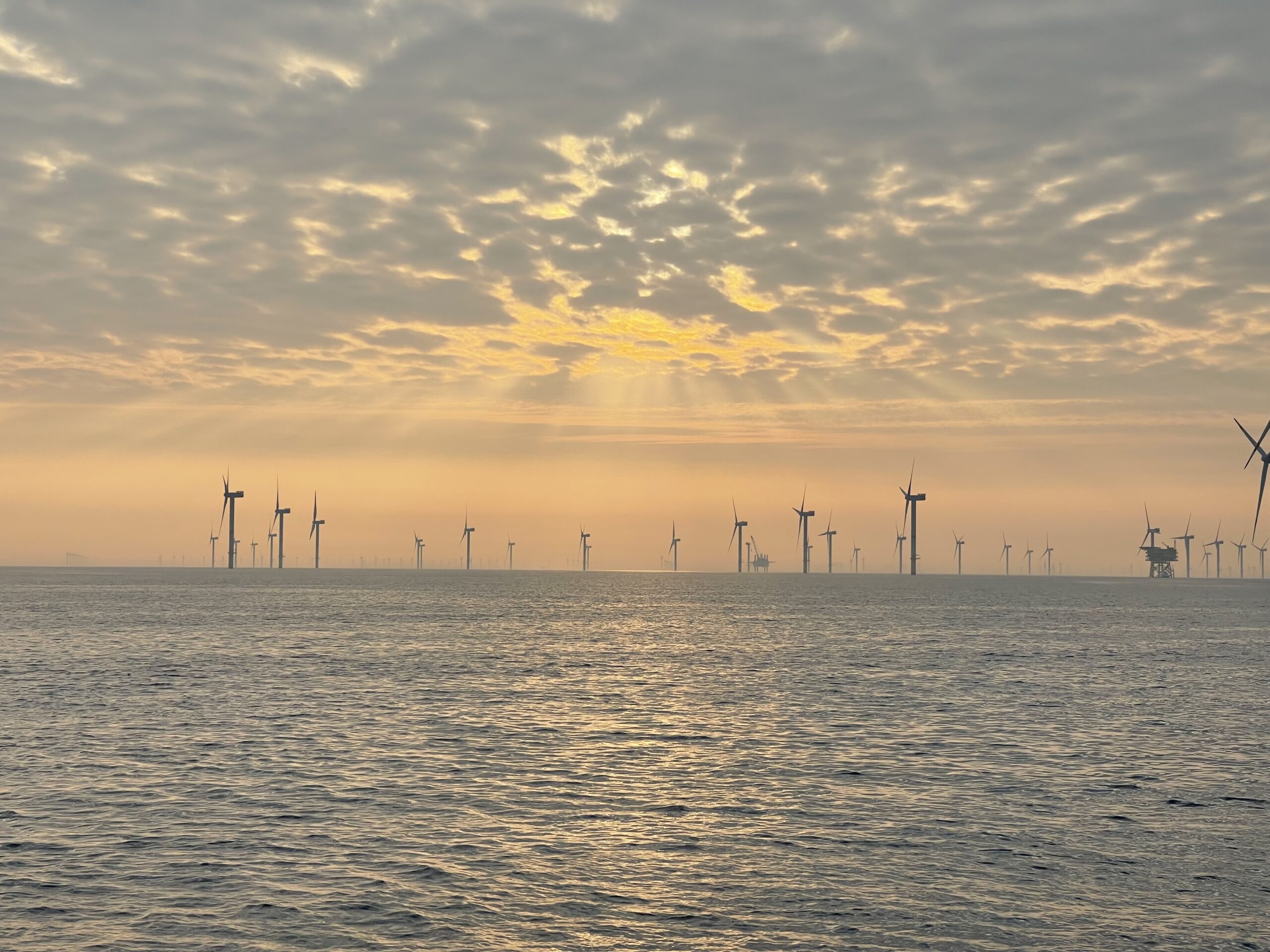
Photo: NORDSEE WIND FARM/By Capmat007 – Own work, CC BY-SA 4.0, Wikimedia Commons