Clean Air Council reports Chester corridor air is generally good to moderate
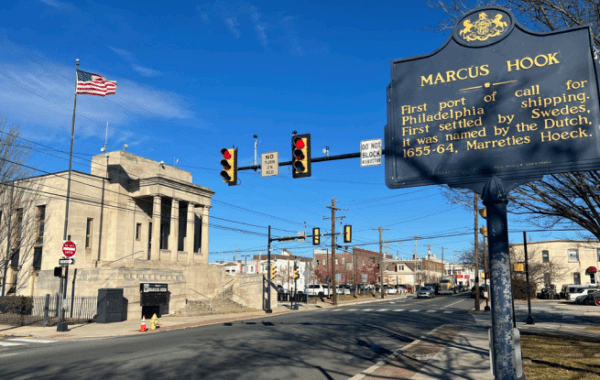
The Delaware County arm of the Clear Air Council has issued its final report on the Chester-Marcus Hook corridor air monitoring program, which shows that air quality in the area of its 30 monitors remains either good or moderate over time except when the area experiences wildfire fallout, and then it veers to the worst rating of “hazardous.”
The report covers 2025 and 2026 through September. The ratings of “good” (satisfactory) and “moderate” (acceptable, but may be unhealthy for sensitive groups) are the top ratings that the U.S. Environmental Protection Agency assigns on its air quality chart.
The CAC’s air quality monitors measure only quantity of particulate matter in the air emitted by air polluting industries, transportation and weather conditions. “Good” is equivalent to a maximum of 9 microns of particulate matter per cubic meter annually. Moderate is 9.1 microns to 35.4 microns while hazardous ranges upwards from 225.5 microns per cubic meter annually.
The EPA used to exclude wildfire results because they were considered “exceptional” events, but wildfire has now become such a common seasonal phenomenon – allegedly due to climate change – that air quality results during wildfires are now analyzed and reported. In this area, wildlife fallout usually comes from Canadian fires in the summer.
The final report was presented by Jendaiya Hall, the CAC’s community organizer, and Alyssa Felix-Arreola, the group’s outreach coordinator. The air monitoring program will continue and interested persons can obtain information about the results from the Clean Air Council’s Philadelphia office.
According to the presenters, there was no one air monitor that consistently reported worse results than the whole network of monitors generally except when there was a specific, short-term reason. In one case demolition debris clogged the nearest monitor and in another, the monitor’s proximity to a scrapyard, since closed, was causing the spikes.
The report coincided with the release of a major 249-page final report published by the Clean Air Council Nov. 3, on the Climate Resilient Communities Project (CRCP). The three-year initiative launched in 2022, focused on Chester, Marcus Hook and Trainer along the Delaware River in Delaware County and on Eastwick and Grays Ferry along the Schuylkill River in Philadelphia.
The project combined climate modeling, environmental research, and resident input with Olin Labs to assess how climate change and industrial hazards interact.Key Findings
The key findings of the study are that climate and industrial risks overlap. Flooding and severe storms can damage industrial facilities, potentially releasing harmful pollutants into air, water, and soil
Researchers identified more than 556 industrial facilities and brownfield sites in the city and Delaware County, including refineries, chemical plants, hazardous waste sites, and other
Eastwick faces extensive flooding risk while Chester & Marcus Hook have many industrial sites in flood-prone area, they said.
In Grays Ferry, limited tree canopy, high paved surfaces, cause heat island effects, while residents are concerned about the lingering pollution at the former Philadelphia Energy Solutions refinery, which is undergoing redevelopment.
The study suggests strategies to address both immediate neighborhood needs and regional policy changes, such as improving emergency preparedness and stormwater management, expanding access to green spaces and green infrastructure, and restricting industrial development risks through stricter environmental review and pollution controls.
Read an overview of the report HERE. Read the full report HERE.
PHOTO/Courtesy of Clean Air Council