Lower Merion is first in PA to ban gas-powered leaf blowers
Lower Merion Township in Montgomery County will be the first municipality in Pennsylvania to totally ban gas-powered leaf blowers, starting in 2029. Here is Delaware County, Transition Town Greater Media is building awareness and community support before seeking similar restrictions.
Lower Merion Commissioners approved the new ordinance by a 10-4 vote. Starting in 2026, leaf blowers will be banned from Jan. 1 to April1 (winter) and from June 1 to Oct. 1 (summer), but they will be allowed during peak leaf cleanup seasons.
On Jan. 1, 2028, gas-powered leaf blowers will only be permitted only from Oct. 1 to Dec. 31. Then the full ban will take effect Jan. 1, 2029.
Only a few other municipalities around the country have banned or restricted gas-powered leaf blowers, including Washington, D.C., Montgomery County, Maryland, Burlington, Vermont and Montclair, New Jersey.
Swarthmore tried for a similar ban last year but it failed to pass and was tabled, which means it could come up for another vote in the future.
Media Borough approved an ordinance last year prohibiting the use of gas-powered leaf blowers from sunset to 9 a.m. while children are walking to and from school, according to Dr. Woody Kotch, a member of Transition Town Greater Media. The Borough Council also tabled the remainder of the proposed ordinance.
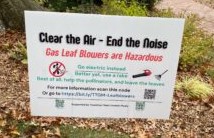
TTGM is building awareness of the issue and seeking community support before asking the Borough Council for any additional restrictions. They have been distributing lawn signs and talking to residents at the weekly Media Farmers Marcket about the issue, Kotch said.
“We’re happy Lower Merion’s ordnance passed. Some municipality had to be the first one. We didn’t want to be first and have to deal with the legal issues that may raise,” Kotch said.
Environmentalists contend that the engines of gas-powered leaf blowers are a major source of both noise and air pollution, disproportionately affecting children and landscape company workers. The noise from the leaf blowers can reach 90 decibels, according to one estimate.
Two-stroke leaf blower engines, commonly used by landscapers and homeowners, burn both gasoline and oil. About 30% of thre fuel they use is unburned and released directly into the atmosphere, according to the Institute for Exposomic Research (IPR) at the Icahn School of Medicine at Mount Sinai. The California Air Resources Board (CARB) estimates that operation of a gas leaf blower for one hour releases emissions equivalent to driving a car for 15 hours or 1100 miles.
Air pollutants released by gas leaf blowers include carbon monoxide, formaldehyde, benzene, nitrogen oxides, hydrocarbons, and particulate matter. In addition to impacting respiratory health and increasing asthma risk and severity, these pollutants are associated with numerous health outcomes including cancer, heart disease, and dementia, IPR says. The institute researches the environmental exposures that individuals typically encounter throughout their lives and how those exposures affect their biology and health.
Opponents of the bans include landscaping companies that argue having to replace gas-powered equipment with electric leaf blowers would be prohibitively expensive. And, they contend that the technology for eqivalent electric gas blowers is not quite fully developed yet.
Kotch said neither of those arguments are valid. Eectric leaf blowers are much better than they were and TTGM may ask council to compromise by banning two-stroke leaf blowers while allowing more efficient four-stroke engines.
As part of its campaign to rasie awareness, TTGM also advises homeowners that they do not have to remove every leaf from their property, they just have to get them off their grass. They can compost and they can even leave 25% of the leaves on their lawns without killing the grass, he said.
“We just have to change our perception of what a good-looking property looks like,” he said.
Jodine Mayberry for the Clearinghouse
Photo courtesy of David Director