County Council to ask voters to okay debt to finance open space projects
Delaware County Council voted 5-0 to place a referendum on the November ballot asking voters whether they favor increasing the county’s debt by up to $120 million to finance land conservation projects, including protecting drinking water sources, preserving wildlife habitat, providing trails and parks and protecting natural aeras from development.
Council members emphasized that the referendum is not a bond issue but rather a request to taxpayers – who have been burdened by massive county tax increases in the last two years – to let them or future councils extend a line of credit up to $120 million over several years for open space projects.
They argued that a yes vote on the referendum does not necessarily mean the county will go out and spend $120 million, just that they would have the cash on hand, like a line of credit, to start or continue long-term projects. Council can still go after state and federal grants and can help finance municipal projects if the referendum is approved.
Parts of the county are plagued by repeated flash flooding from its many creeks. The money could be used to help communities to mitigate flooding by improving stormwater infrastructure and preserving wetlands that can absorb stormwater and reduce flooding, according to the county planning department.
It can also be used to develop Delco Woods in Marple for parks, trails and recreation and to provide tools to resist data centers and large-scale warehouses.
Councilwoman Elaine Paul Schaefer said that if the referendum is approved and if council spent the whole $120 million, the total burden on taxpayers owning the average home would be $24 a year. Councilwoman Christine Reuther further noted that the average home sells for about $400,000.
“Talk about taxation without representation, I can’t think of any better representation than to put it to the voters,” Councilwoman Joanne Phillips said.
“I have every confidence in the world the public will vote for it because they know the value in their lives of open space and clean water,” Schaefer said.
Members of the public who spoke in favor of the referendum included representatives of several conservation groups who said open space would attract more residents and investors, while those who spoke against it declared it was just another tax put upon “people who are already struggling” with multiple levels of taxation.
David Director, a member of the Delaware County League of Women Voters Environmental Committee, which sponsors and maintains Clearinghouse, and a member of the county Sustainability Commission, talked about the economic benefits of open space spending.
Protected open spaces provide over $14 million in annual “ecosystem services,” including removing air pollution, replenishing our water supply, mitigating floods and other benefits, he said. In addition the county’s parks, trails and creeks provide $140 million in yearly recreational benefits, according to a 2022 county environmental study, he said.
“As any investment advisor will tell you, the best way to fund a long-term asset is with long-term financing, and a bond issue fills that need perfectly. In this case, it’s like a home equity line of credit, which you can draw on gradually, as needed, for renovations or home improvements, and pay back over time,” Director said. Many of our residents are familiar with such arrangements, and indeed, have made good use of them.”
One speaker wondered whether half the proposed debt is already earmarked for Delco Woods, the county’s undeveloped parkland in Marple, while another decried the value of storm water mitigation, saying flash flooding “wasn’t invented last year, it’s been around since Biblical times.”
By Jodine Mayberry for the Clearinghouse
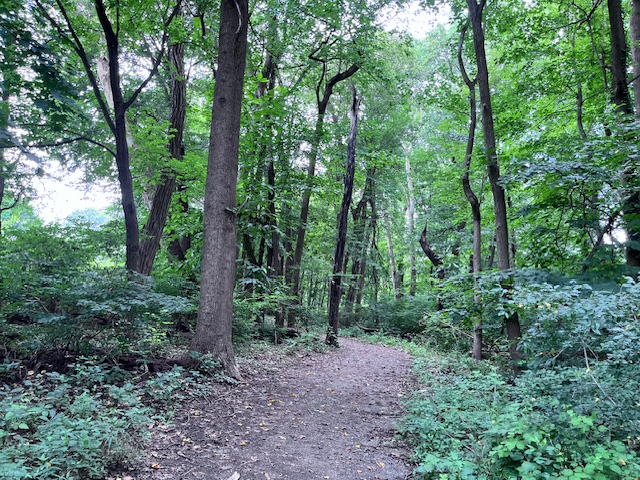
Photo/Furness Trail, Nether Providence, Clearinghouse